
Draft: 2025-02-24
Work in PROgress.
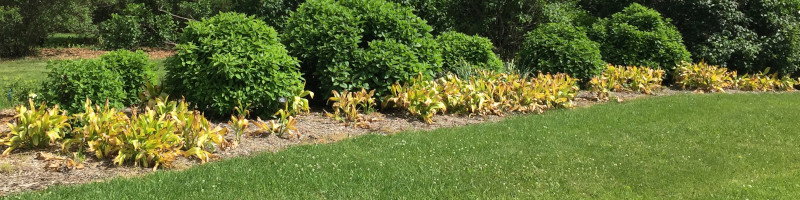
Featured image: A cultivar of a pine tree, which has yellow needles. They become yellower in winter. It is not a symptom of a disease, it is a heritable trait. UW-Arboretum, Longenecker Horticultural Gardens (LHG).
The interaction between pathogens and host organisms (plants) cause disease. The study of plant diseases and other similar interactions between organisms and plants is called Plant Pathology. Since plants are part of our diet, our livestock’s diet, and are part of a global ecological web, it is necessary to study their afflictions in order for us to survive. In addition, plants contribute materials necessary for our survival like wood, and other materials, which have contributed to our abilities as a species and quality of life.
When a plant is healthy it is completing its meristematic growth and the rest of the physiological functions, particularly those which influence the quality of the products we derive from them. The meristem is the living portion of the plant. When we look at trees, we could compare them with coral, with a living surface and an inert interior. For this reason, some old trees have hollows inside, yet can still survive to an old age. However, if critical portions of the outside of a plant become damaged, the tissues that carry water and nutrients can desiccate and the damages can go up the entire plant.

Two different plant species (Left: Bittersweet nightshade, Solanum dulcamara; Right: Mulberry, Morus alba) along a service road near a golf course show disease symptom of yellowing leaves, known as clorosis.
The cause is identified upon further inspection. The stems of the chlorotic leaves is girdled, either because of a crafty human wishing to teach bystanders plant physiology or because of some unknown process (herbivory, disease [stem canker], etc…).
Stem canker is a disease caused by pathogens. For example, stem canker of Mulberry is caused by the fungus Lasiodiplodiae theobromae. L. theobromae has a large host-range, and therefore can affect many other species. Alternaria stem canker of Tomato (Solanum lycopersicum) is caused by the fungus Alternaria alternata f.sp. lycopersici *
No other plants in the vicinity exhibited these symptoms, so my hypothesis is the former or first option.
* forma (f.) – organism with a consistent morphological difference (ex: flower color), yet within clade.
* forma specialis (f.sp.) – variety of a pathogen with specific host.
Plant disease diagnostics is a step-by-step process, which follows the emergent properties principle of biology. The first step requires the observer to assess whether the symptoms are normal traits of the plant.
Obligate parasites

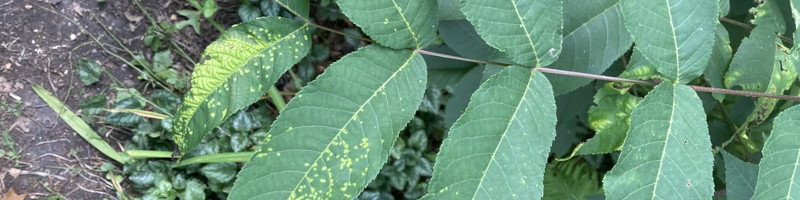

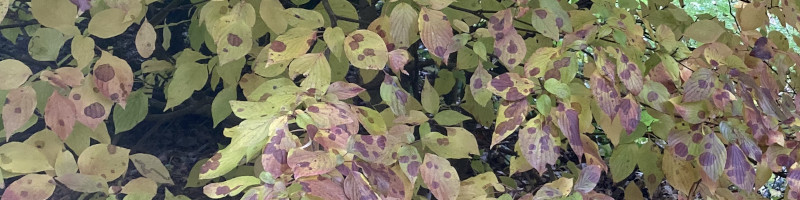

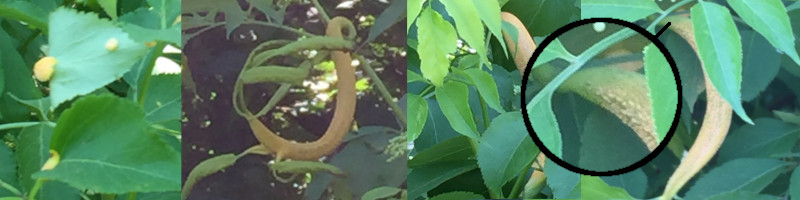
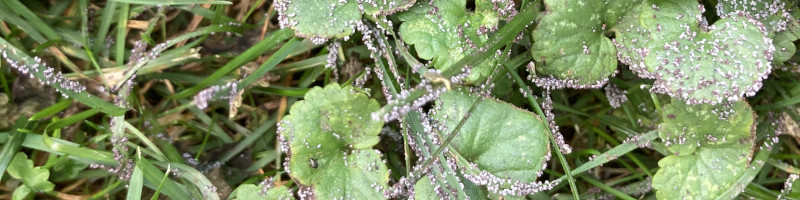
This phenomena is not considered a disease, nor is the causal agent considered a pathogen by plant pathologists, because Plasmodia feed on plant debris, and many cases appear only after rainfall, only to then disintegrate back into the soil.
The observed growths in the photograph are fruiting bodies of a Plasmodium.

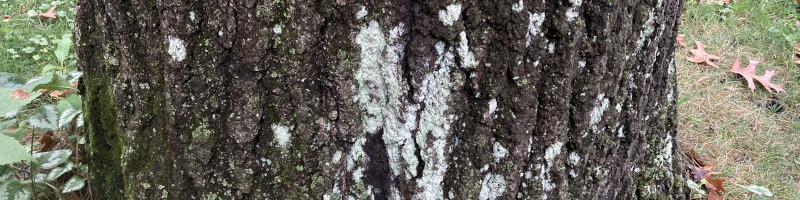

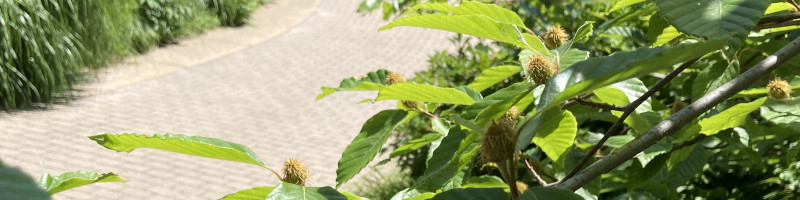


Entomologists study how arthropods, specifically insects, utilize plants as homes and food. Since humans and animals consume plants, we compete with arthropods, which eat tissues, defecate, and proliferate inside of the plant tissues we want to consume. This poses health risk to food, yet it is a common and favorable occurrence in nature, since we need arthropods for the food chain to work, for flowers to pollinate, and so on.


Some plant disease pathogens have alternate hosts, they need to live on one species for a season, then another species, in order to survive. In the case of Apple-Cedar Rust, the pathogen makes fruiting bodies on what we call Cedar, or Eastern Red-Cedar (Juniperus virginiana), and then will infect the fruit of Apples (Malus spp.) but also Hawthornes (Crataegus spp.), which are closely related within the family Rosaceae.
Plant Pathology intro
Non-disease
Economic value of plant diseases
Insects, arthropods, entomology intro
Pathogens and common diseases
Economic costs of plant diseases
Pesticides
Since ancient times, chemicals have been used to treat plant diseases. In the past, people did not know about the concept of chemicals, nor what active ingredient, yet they observed interactions between materials. For example, they used minerals, like sulfur, and other plants, like Chrysanthemum, to treat plant diseases. As people began to discover chemistry, they isolated the active compounds and used them without the spectrum of other chemicals in natural sources like plants, at higher toxic doses, and altered them to change their function or to be able to patent them, in order to earn money from their use. This change in the use of pesticides is called the Synthetic Pesticide Era (1939).
Prior to the Pesticide Era, scientists were using chemistry to hurt humans and the environment in World War 1 (WW1) (1914-1918). Many agricultural companies formed after this event, and they repurposed their understanding of chemistry to solve agricultural problems, instead of war. However, their chemical perspective of the world would prove to become destructive, since they discovered and invented new chemicals, yet they have not been able to foresee the consequences until after the damages occur. Even so, scientists continue to develop new chemicals with the hope this time it will be different, even though they’re continuing to understand the world in a myopic way (small focus), instead of viewing it holistically (full perspective).
Even after WW1, chemicals, which were classified as pesticides, were still being used against humans, such as during the holocaust, where they were used by the Nazi government to kill imprisoned criminals, imprisoned ethnic minorities (Jewish, Roma, etc…) and others imprisoned because of their sexual orientation, political views, or social aptitudes. The use of pesticides in genocide makes them a sensitive topic.
In the environment, pesticides have also created lots of harm. For example, in the 1950’s pesticides began to affect bird populations, since they caused their eggshells to thin. During this time, people also learned how another pesticide, Rotanone, killed fish in rivers and lakes. Even in the 2000’s, people observed the damages caused by neo-nicotinoids, synthetic compounds derived from nicotine, which had been banned for its potency. Studies show how neo-nicotinoids have caused decline in bee populations and other pollinators necessary for the production of fruit and the reproduction of plants in the wild.
All of these consequences have inspired scientists to use Genetic Engineering (GE) technologies to cause the plants to produce pesticidal compounds in their cells. For example, Bt-technology is the genetic modification of organisms like corn (Zea mays) to produce insectidal crystals discovered in the bacterium Bacillus thuringensis, which disrupt the guts of caterpillars and the larval stages of boring weevils, which chew holes in the corn kernels. In the beginning stages of Bt-technology, scientists discovered it was killing a non-target species, Monarch butterflies (Donaus plexippus). Monsanto responded by altering its genetics further and re-distributing the seeds to its farmers in order to remove the variant from the fields. The other famous GE technology, gives plants resistance to the herbicide glyphosate, also known commercially as Round Up, so the genetically modified plants do not die when the glyphosate kills the other plants. While these may seem like smart alternatives, they have introduced new risks, which affect the future of plant life on Earth, since they create genetic bottlenecks in plant populations and coerce farmers through economic strategies. Because of the wealth created through these companies and the others that depend on them, there is doubt that the risks are being represented honestly.
Within the last decades, efforts have been made to end the use of synthetic pesticides and promote organic agriculture. Agencies like the USDA are responsible to create definitions to these terms, and concluded that since pesticides are so common in agriculture, organic doesn’t mean pesticide-free, rather it means cultivation of crops with organic pesticides. However, many organic pesticides are just as harmful if not more harmful (ex: nicotine, rotanone), and so they must restrict their use.
As you can see, the pesticide era has introduced many problems to humanity and life on Earth. Likewise, all equally complicated attempts in order solve these problems have introduced problems of their own. Scientists’ paradigm or worldview causes their solutions to problems to be as complicated and impactful as the problems. All of this is also connected to how the advances in chemistry affect the way we view the role of chemicals in the environment.
Non-chemical methods
Because of the problems caused by pesticides, scientists in universities have created an approach to plant disease management called Integrative Pest Management (IPM), which emphasizes the use of non-chemical methods before pesticides. However, this protocol has been created in order to allow pesticides, which have been determined as necessary, which also accommodate the economic regime that benefits from their use, rather than making a concerted effort to find non-chemical alternative methods.
This is an important concept to discern, because many of the non-chemical methods are taught under the IPM system, which is a more merciful and educational change for people who’ve been convinced only chemicals work, yet it is not the true alternative many people seek.
IPM also teaches other awareness techniques, which diminish the quantity of pesticides used and changes the way we perceive the environment, because it teaches a holistic approach to pest management. For example, IPM teaches when insect populations can constitute an economic risk, and takes into account their ecological role. Therefore, IPM cares about thresholds, which permit a certain amount of pests.
Cultural controls
Among the many non-chemical methods, cultural controls is the most diverse category, which includes any physical effort in the cultivation of plants, which disrupts the life cycles of pathogens, pests, or prevents disease by changing the environmental conditions.
Many pests leave a survival structure on the leaves of plants, the simple act of cleaning leaf debris in the autumn, when the leaves of deciduous plants dehisce, can disrupt the pest’s life cycle and cause their populations to drop to an acceptable threshold.
Diseases can also be prevented by using proper sanitation methods of pruning shears, which can transmit diseases through contact with vascular tissues. Bleach was used in the past, however it was found to oxidize metal, and so now Lysol is used.
Other diseases also proliferate in certain environmental conditions. Pruning or training of limbs can cause open spaces where air can flow or sun can penetrate and prevent excessive continuous moisture or dark environment.
Similarly, choosing the right location for plants can be the most important decision a farmer makes. This is called site selection. Yet, often people decide based on economic reasons, void of any ecological context. For example, there might be a crop which earns a farmer money, and so it is planted in a farm, yet the location is not optimal for the species and contributes to diseases and crop failures. Studying the crop species and their native environments can help farmers understand their most productive environments and introduce breeders to the diverse genetics, which exist naturally in the wild or historically cultivated regions.
Companion planting is one method, which can optimize health of plants, because the companion plant species can either re-direct the pests (sacrificial plants) or attract other beneficial insects, which eat or parasitize the pests. Companion plants could also exude secondary metabolites, which deter the pests or pathogens of the crop species. There could also be favorable soil microbiome interactions between companion plants and crop species. Permaculture and forest gardeners like Martin Crawford also observe how annual crops cause energy-exhausting detrimental changes to the soil, where as perennial plant crops like shrubs (berries) and trees (fruit) can have less of an impact.
Gustavo Meneses
PlantResearchORG
Plant Pathology
2025-01-31
- Plant pathology
- Main picture: diseased plant
- Picture of red algae Gracilaria and phylogenetic relationship to plants diagram
- Quote from Koch about pure culture (Agar, petri dish).
- Explanation of importance of Gracilaria and red algae
- Introduction
- Disease comes from pathogen interaction with host.
- Time, life stages of plant, relevance to economy and ecology.
- Pests included within study of plant pathology.
- Plant physiology, agriculture/horticulture
- What organs are harvest for consumption?
- What organs are vital for plant survival and product quality/quantity?
- Disease comes from pathogen interaction with host.
- Pathogens
- Can exist as normal, and same species as harmful (forma specialis) (ex: gut bacteria and e coli).
- Disease
- What isn’t disease (First step of diagnosis)
- Genetics
- Yellow cultivars
- Olbrich Gardens
- Meristematic damage
- Herbivory
- Genetics
- Koch postulates
- Understanding disease agents
- Inoculation, experimentation
- Understanding disease agents
- What isn’t disease (First step of diagnosis)
- Importance
- Losses
- How are losses calculated?
- %0.5 of yield (1918) vs. today’s measurements (USDA Plant Disease Reporter 1918).
- 0.005 ∗ Yield = reduction
- (reduction * (production + reduction )) = percentage of loss
- What about Yield vs. Production? Think processing, transport, and spoilage losses.
- %0.5 of yield (1918) vs. today’s measurements (USDA Plant Disease Reporter 1918).
- How are losses calculated?
- Losses
- Pests
- Herbivory (leaves [vital for photosynthesis], meristem [transport], fruit/seed [cultivation/product]).
- Life stages
- Foreign substances in product (pests, frass)
- Herbivory (leaves [vital for photosynthesis], meristem [transport], fruit/seed [cultivation/product]).
- Picture of red algae Gracilaria and phylogenetic relationship to plants diagram
- Plant microbiome
- Protozoa
- Bacteria
- Fungi
- Arthropods
- Plant diseases
- Historical
- Economic impacts
- Gains
- Oak gall
- Dyes
- Food
- Huitlicoche
- Losses
- Growth issues
- Fruit and tissue damage
- Taste
- Aesthetic
- Cost of management
- Inputs
- Pesticides
- Preemptive
- More common
- Treatment
- Difficult and unlikely to cure
- Preemptive
- Equipment
- Training
- Regulations
- Pesticides
- Inputs
- Gains
- Ecological impacts
- Non-target species
- Pesticide resistance
- Worker health
- Consumer health
Gustavo Meneses
PlantResearchORG
Plant Pathology
2025-01-20
Plant Pathology
(zig-zag model of plant immune response)
The interaction between pathogens and hosts cause disease. The study of plant diseases and other similar interactions between organisms and plants is called Plant Pathology. Since plants are part of our diet, our livestock’s diet, and are part of a global ecological web, it is necessary to study their afflictions to survive. In addition, plants contribute materials necessary for our survival like wood, and other materials, which have contributed to our abilities as a species and quality of life.
(potato blight example, factor in Irish famine and US migration)
Plant Microbiome
(examples of biomes in nature, macroscopic)
Plants are not isolated objects within an ecosystem, rather living systems, which not only interact with the environment, yet also are homes for other distinct organisms.
Protozoa
These organisms are very simple and often confused with bacteria.
Bacteria
Bacteria are often spoken about as germs, or microscopic disease causing organisms. However, bacteria are diverse and play a vital role in larger more complex living systems, like plants and also humans.
Fungi
Often compared to plants, fungi are actually more similar to animals in their cellular structures. Fungi are also often identified by their fruiting bodies, yet exist most often as hyphae, or vein-like structures, which are alive but can also go dormant.
Arthropods
When we think of bugs, we can sometimes include organisms, which are not insects, like rolly-pollies (Armadillidiidae), which are more similar to crustaceans like lobsters and crabs. For this reason, it is more accurate to talk about arthropods, which broadens the category to an understandable and functional group. Arthropods have live alongside plants for millions of years, and have established very special interactions with plants, for example: pollination. Plants rely mostly on arthropods to pollinate plants. Arthropods can also interact and defend plants from problems, though many times they cause them.
Plant Diseases
When a pathogen alters the function of host organism in a significant and relevant manner, then it is considered diseased. In the past this was observed later than expected, which resulted in crop failures, because either the entire plant perished or the harvested organs were damaged. Today, plant pathologists look for signs to diagnose these diseases, and recommend farmers methods to prevent them. Unfortunately, much of the treatment is preventive and once a crop is damaged, there are often less opportunities for farmers. Many diseases can change the chemical composition of crop organs. Therefore, plant pathologists must scout intensively.
Potato blight
Potato blight is a disease caused by an oomycete, a unique eukaryotic organism similar to fungi. After the colonization of the Americas by the Spanish, potatoes were introduced to Europe. The selection of potatoes, which were grown in Europe, was much less diverse than in its native range. Thus, plant pathologists have determined the genetic diversity of the crop affected its disease resistance abilities. During harsh political conflict between Irish and English, Irish farmers’ crops failed and a famine began. The Irish were then removed from their homes, and their oppression continued despite the crop failures. This drove a large migration of Irish to North America.
Wheat rust
Wheat rust is a disease caused by a fungal pathogen with alternate hosts, meaning it lives inside one plant species, where it lives dormant, then spreads to another, where it creates fruiting bodies that interfere with agricultural activities. The alternate host for wheat rust is Barberry. USDA encouraged farmers to remove all Barberry bushes in order to prevent wheat rust from affecting crop performance. Wheat rust causes tissues in the grain to deform, produce toxic compounds, and eventually become a fruiting body, which releases spores.
Economic impacts
Gains
Not all plant diseases cause crop failures, in Mexico, a disease of corn called Huitlicoche is considered a delicacy and provides the corn with a different nutrient profile.
Other plant diseases like oak galls, caused by gall wasps, were harvested and used to produce an ink used for writing manuscripts. Later this ink was enhanced with iron for a darker color, and called iron-gall ink.
Because plant diseases can change the chemical composition of plants, dyes and other products can be derived from diseased plants.
Losses
Plant diseases affect growth of plants, which in turn can cause crop failures.
Of all tissues in the plant, often the most concerning are the fruit. Damage to fruit because of disease can cause changes in the taste of the fruit, but also the appearance of the fruit, which may not affect taste or safety, yet is not preferred by uneducated or picky consumers, who are suspicious of them.
Plant diseases also create losses through the costs associated with their management. Farmers are often encouraged to spend extra money on inputs like pesticides. Pesticides are often preemptive, and treatment of existing disease can be difficult. Plant pathologists will determine whether a problem with the crop is disease-related or if it is from another source, like cultivation practices and site-selection.
Farmers will also need to spend more money on the equipment necessary to deploy pesticides. Pesticide application requires a special training program and license. Regulations also protect workers and farmers by describing the necessary time intervals between pesticide applications and farm work.
Ecological impacts
Pesticides, which also include fungicides, can also impact the environment. Some pesticides are known as broad-spectrum, which target a large variety of arthropods, fungi, or other organisms. These and other more specific pesticides can be dangerous, because they can affect non-target species. Without the ecosystem services, crops will not be pollinated and will not produce any yields.
Pesticides can also affect worker health. For this reason, regulations are set in place to protect workers, which include farmers and farm owners, from exposure.
Likewise, pesticides can also affect consumer health. For this reason, many consumers look for USDA Organic labeled products. However, even USDA Organic product labels permit the use of organic pesticides. Organic pesticides can still be detrimental. For example, nicotine is banned, because it is an extremely potent pesticide, which causes insect populations to fall. This includes honey-bees and other insect populations, which are used to produce products.
References
Agrios, George N. “Plant Pathology”, 5th Edition. 2005. Department of Plant Pathology, University of Florida. Elsevier Academic Press. ISBN: 0-12-473276-3
p.390-391 (Fungi-like organisms)
p. 287 (Expert systems are computer programs, ex: BLITECAST [computerized forecast for potato late-blight, original 1975], TOM [tomatoes], GrapES [grapes], CONSELLOR and MoreCrop [wheat], CALEX [peach and nectarine], POMME and Penn State’s PSAOC [apple].
p. 289 (Decision Support Systems [DSS] collection of data and tool to assist human, which can include an Expert System computer program, ex: WISDOM for potatoes at Univ. of Wisc., RADAR for apples at Univ. of Maine, PAWS for several at Washington State Univ., Fieldwise.com, AusVit DSS in Australia for grapes).
http://www.eagri.org/eagri50/PATH371/lec18.pdf
https://plantpath.ifas.ufl.edu/u-scout/tomato/alternaria-stem-canker.html
https://www.sciencedirect.com/topics/agricultural-and-biological-sciences/lasiodiplodia-theobromae
https://pmc.ncbi.nlm.nih.gov/articles/PMC8544537/
https://commons.wikimedia.org/wiki/File:Red_algae_(Gracilaria_sp.)_(48737220543).jpg
https://commons.wikimedia.org/wiki/File:Plant_phylogeny.png
https://www.researchgate.net/publication/291036369_Gracilaria_vermiculophylla
https://archive.org/details/croplossesfrompl06unit/page/189/mode/2up
https://archive.org/details/plantdiseaseloss193ches/page/208/mode/2up
https://turfpestlab.psu.edu/pest-profiles/slime-mold/
https://www.plantpathlesstraveled.com/turf-grass-slime-mold/
 PRO - Plant Research Organization
_(48737220543).jpg)
